Creating an IRS Online Account
For your average taxpayer, filing their yearly tax return can be confusing and frustrating. There are many tools and resources out there that can help the individual taxpayer, and one of them is an IRS Online Account.
From accessing the adjusted gross income (AGI) from their prior year’s tax return, which is needed to file their current year tax return electronically, to tracking the status of their refund, creating an IRS online account is worth the effort.

Why Should an Individual Set up Their IRS Online Account?
By gaining access to their IRS Online Account an individual, at a minimum, will have access to the information on their most recently filed federal tax return as well as the three prior year returns. They will also have the ability make payments, see their payment history, have access to any notices that were sent to them, and other information related to their account with the IRS.
What Information is Included in an IRS Online Account?
An individual can view the following while in their IRS online account:
- Key information from their most current tax return
- Their address the IRS has on file
- If they owe taxes or have made payments to the IRS they can view:
- The amount of any tax they may still owe
- Their payment history
- The balance for each year for which they owe taxes
- The details of any payment plan that they have set up with the IRS
- Digital copies of any IRS notices that they have received
- Prior year Adjusted Gross Income
- Status of Refund or amended return
- View information return documents such as certain 1099s and W-2s
- View their audit status (for certain audits conducted by mail)
An individual can also use their IRS online account to:
- Access their tax records for the current year and three prior years. The information for each year’s return is in the form of an IRS transcript which the individual can view and print out and/or download
- Make payments by selecting an electronic payment option
- Set up an online payment agreement
- Approve and electronically sign a Power of Attorney from their tax professional
How to Set Up an IRS Online Account
To set up their IRS Online Account, an individual will go to Your Online Account on the IRS website and select “Sign into your Online Account”.

What Information is Needed to Create an Online IRS Account?
To access their account information, an individual will need the following to verify their identity:
- Email address
- Social Security Number
- Photo ID (driver’s license, passport, passport card, or state ID)
- Mobile phone with camera
Once they have these items, they will select “Create an account with ID.me” on the IRS Online Account Sign in page and will do the following:
- Enter an email address they can access and choose a password
- Accept ID.me’s terms and conditions and select “Create account”
- Select a multi-factor authentication option such as “Text message, phone call, etc.”
- To verify who they are, they will have the option of Self Service or verify via video chat.
- If they select the Self Service option, they will:
- Take a picture of their photo ID and upload it to ID.me. The types of photo ID that can be used are a driver’s license, State ID, passport or passport card.
- Take a video selfie of themselves and submit it to ID.me
- Enter other request information and their Social Security Number
- If they Select the verify via video chat option, they will:
- Take a picture of their photo ID and upload it to ID.me. The types of photo ID that can be used are a driver’s license, State ID, passport or passport card.
- Connect with a Video Chat Agent and they will verify their identity during the video call session.
Once they have completed the verification process when setting up their IRS Online Account, the taxpayer will also have access to other IRS online tools such as:
For more information see the following:
- IRS and ID.me – For more detailed explanation of Self Service and Video Chat option
- Your Online Account on IRS website
- Frequently Asked Questions About Online Account on IRS website
Is There an Online IRS Account for Businesses?
The IRS has enabled a business online account. For now, the business online account is only for sole proprietors who have employees and/or must file highway use tax Form 2290.
Here is what a sole proprietor may do inside their business online account related to their employment tax or highway use tax:
- View any balance due
- View their business tax records (employment tax filings and Form 2290 filing)
- View select digital notices related to employment taxes and highway use tax
- View business name and address information
- Give account access to your employees
- Register for clean energy credits – if they are eligible
For partnerships and S-Corporations, a partner or shareholder who has an SSN and was issued a K-1 may view the following:
- View a balance due for the partnership or S-Corporation
- View the partnership or S-Corporations tax transcripts
- View business name on file with IRS
The IRS will be adding more functionality to the business online account in the future.
See the following on the IRS website for more information:
- Business tax account page
- IRS News Release IR-2023-243 (IRS expands business tax account access to S Corporation, partnerships)
IRS News Release IR-2023-194 (IRS launches new initiatives using Inflation Reduction Act funding to ensure large corporation pay taxes owed; continues to improve and modernize technology with launch of business tax account)
CrossLink Professional Tax Software
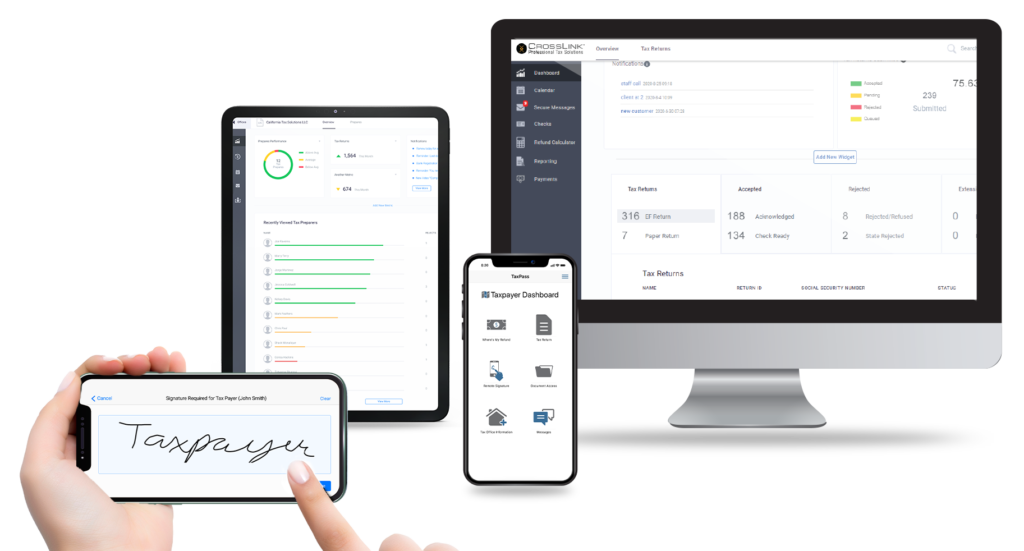
CrossLink is the industry’s best professional tax software solution for high-volume tax businesses. Built based on the needs of busy tax offices and mobile tax preparers that specialize in providing their taxpayer clients with fast and accurate tax returns, CrossLink has been a trusted software solution since 1989. CrossLink’s in-depth tax calculations, advanced technological features, and paperless solutions allow you to prepare the most complicated tax returns with confidence and ease while providing your customers an unparalleled experience.